Select Focus Area
Child Protection
Early Childhood Development
Education
Emergency Response
Environmental Sustainability
Food Security & Livelihoods
Health & Nutrition
Water Sanitation & Hygiene
Youth Development
Select Type
Capacity Statement
Case Study
Collection Stories
Learning brief
Manual, Toolkit or Guide
Policy Brief
Project Brief
Report
Research
Strategic Framework
Select Year
2025
2024
2023
2022
2021
2020
2019
2018
2017
Select District
Chibombo
Chongwe
Countrywide
Mumbwa

2025

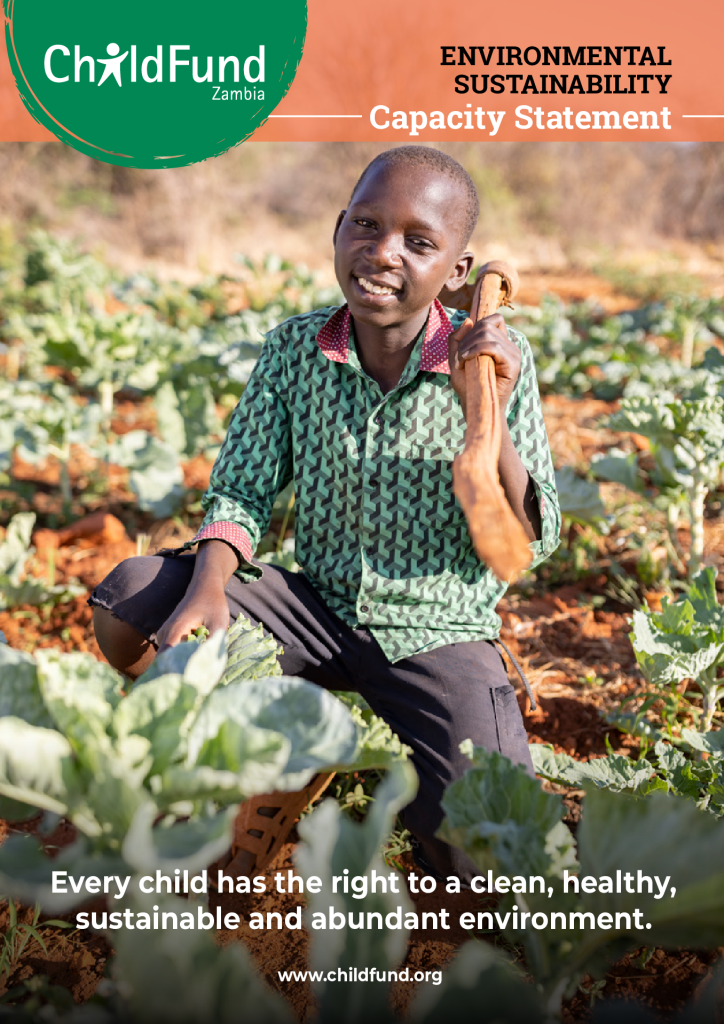
ChildFund is committed to tackling environmental challenges through innovative, child-centered solutions that build community resilience, promote clean energy, and support sustainable livelihoods. This capacity statement outlines our proven approaches, such as smart agriculture, biodigesters, and fuel-efficient stoves, that reduce environmental impact, improve food security, and empower youth as climate leaders. Aligned with Zambia’s NDCs, NAP, and global frameworks like the Paris Agreement and SDGs, our work prioritizes environmental education, green job creation, and locally driven action for lasting change.
2022

This document outlines ChildFund Zambia’s five-year strategic direction, programmatic priorities, and development goals aimed at improving the lives of vulnerable children and their communities across Zambia. This Country Strategic Plan 2022–2026, is a roadmap that reflects the collective vision and efforts of our dedicated staff, local partners, community volunteers, and global stakeholders. This plan guides our work to ensure that every child in Zambia grows up in a free, safe, and nurturing environment.

2023

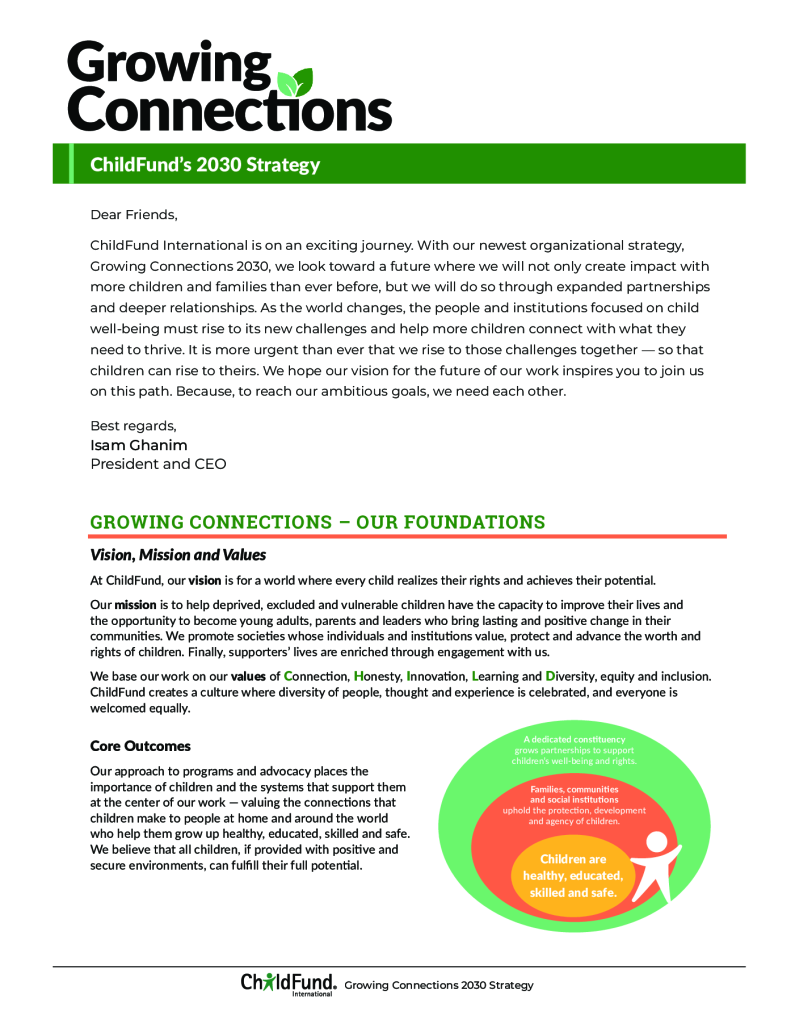
ChildFund International is on an exciting journey. With our newest organizational strategy, Growing Connections 2030, we look toward a future where we will not only create impact with more children and families than ever before, but we will do so through expanded partnerships and deeper relationships. As the world changes, the people and institutions focused on child well-being must rise to its new challenges and help more children connect with what they need to thrive. It is more urgent than ever that we rise to those challenges together — so that children can rise to theirs. We hope our vision for the future of our work inspires you to join us on this path. Because, to reach our ambitious goals, we need each other.

2019

When young people are not active participants in the decision-making processes that affect their lives, they—and their communities—often suffer worse outcomes. Too often, decisions that will affect young people’s lives are made solely by parents, local and religious leaders, teachers, governments and others without the input of youth themselves. Young people who are in marginalized communities, living with disabilities, or facing unfair gender disparities face even tougher development barriers to having their voices heard. By focusing on youth agency and positive youth development, ChildFund supports the principle that young people are empowered to reach their full potential through skill-building, fostering healthy relationships, strengthening families and communities, and transforming systems.

2020

Young people make up a huge proportion of the world’s population. Roughly 1.8 billion people are between the ages of 10 and 241, and the challenges they face today are stark: In 2020, more than 1 in five young people worldwide aged 15-24 was not employed, in job training or in school, and this has only worsened since the COVID-19 pandemic. ChildFund’s livelihood programming focuses broadly on youth work and entrepreneurial skills, employability and work readiness. Many of our programs also overlap with youth participation programming and adolescent sexual and reproductive health so we are able to holistically support youth through this life stage, properly preparing them not only for work, but for being able to stay employed, continue their education and remain safe and healthy.

2020

At ChildFund, we characterize our impact in Africa, Asia, and the Americas using four key dimensions: (1) the positive change we see in our core outcomes as measured by performance data — our global monitoring of key indicators and our programming evidence; (2) by the feedback we receive from children, families, sponsors, partners, and stakeholders on how our work with them has made a positive difference in their lives — and in their communities; (3) how we apply learning about what works well and does not work well in our programs and strategies to improve outcomes; and (4) how we contribute to global, collective outcomes for children and their families — the Sustainable Development Goals (SDGs).

2019

ChildFund believes that by acting in partnership, we can achieve long-term sustainability of social impact and programs to have a multiplier effect on society—reaching marginalized and vulnerable children directly, but also involving parents and other civil-society actors and organizations who are responsible for child development and upholding child rights. As such, we currently implement our activities through and with over 200 local partners in 23 countries of Asia, Americas and Africa.

2017

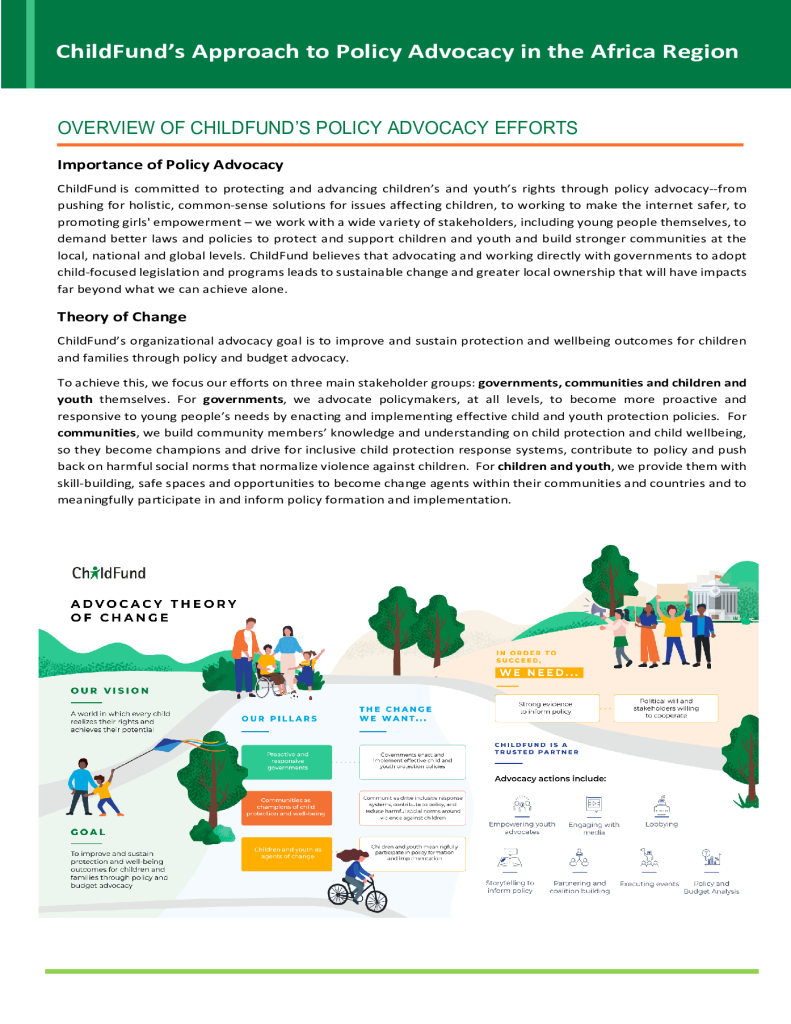
ChildFund is committed to protecting and advancing children’s and youth’s rights through policy advocacy - from pushing for holistic, common-sense solutions for issues affecting children, to working to make the internet safer, to promoting girls' empowerment – we work with a wide variety of stakeholders, including young people themselves, to demand better laws and policies to protect and support children and youth and build stronger communities at the local, national and global levels. ChildFund believes that advocating and working directly with governments to adopt child-focused legislation and programs leads to sustainable change and greater local ownership that will have impacts far beyond what we can achieve alone.